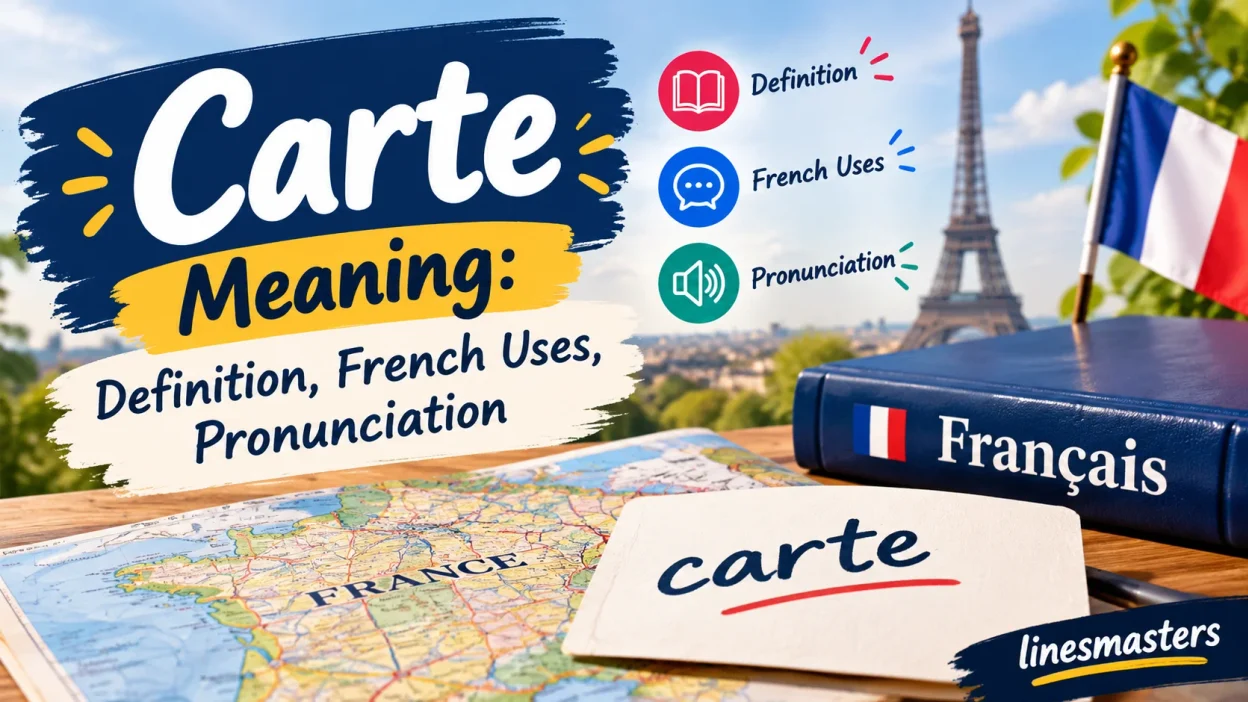
Carte Meaning: Definition, French Uses, Pronunciation becomes easier when you understand its definition, French uses, pronunciation, and context, especially as an English speaker learning the word.
In French, carte can mean a card, map, playing card, identification document, or restaurant menu, so a direct translation can be tricky. A useful approach is to study the surrounding words and the specific situation. For example, carte bancaire means bank card, while carte routière means road map.
You may also see carte d’identité for identification, or carte de France when discussing France and geographical terms. At a restaurant, la carte is the list of available dishes and drinks, while à la carte is common in restaurant expressions. The word also appears in menus, business meetings, and old novels, as well as everyday English. Some expressions, such as carte blanche, describe a choice given to someone, while a written list or document can carry another sense.
These phrases and common expressions show why French speakers use the word naturally in different situations. Online explanations may surround the topic with dictionary jargon, but the clear answer comes from the picture created by each context. These distinctions make carte a useful word to learn, and a good guide is to focus on the language, French expression patterns, and meanings that reduce confusion and help you recognize the word naturally.
Quick Answer: What Does Carte Mean?
Carte is a French feminine noun that commonly means “card,” “map,” or “menu,” depending on the situation. It can also describe a playing card or various official and membership cards.
For example:
- carte bancaire = bank card
- carte d’identité = ID card
- carte routière = road map
- carte à jouer = playing card
- carte du restaurant = restaurant menu
- à la carte = allowing individual choices from a menu
The French pronunciation is roughly /kaʁt/. English speakers can think of it as something close to “kart,” although the French r has a different sound. Cambridge gives the French pronunciation as /kaʀt/.
Carte Meaning in English
In English, carte usually appears as a borrowed French term rather than as an everyday standalone word.
Its most familiar appearance is à la carte, especially in restaurants. When a restaurant offers dishes à la carte, customers select individual dishes rather than automatically taking a fixed meal.
However, the French word itself has a much wider range of meanings.
| French expression | English meaning | Context |
| une carte | a card | General |
| une carte bancaire | bank card | Banking |
| une carte d’identité | ID card | Identification |
| une carte routière | road map | Travel |
| une carte géographique | map | Geography |
| une carte à jouer | playing card | Games |
| la carte du restaurant | restaurant menu | Dining |
| à la carte | individually selected | Dining and general use |
This is why translating carte word-for-word can cause problems. The surrounding words usually reveal the intended meaning.
Cambridge lists carte with meanings including map, postcard, ID card, card, playing card, and restaurant menu.
Carte Meaning in French
In modern French, carte is a broad noun with many practical uses. Its basic sense often involves something made from paper, card, or another flat format that carries information or represents something.
Larousse traces the word to the Latin charta, meaning paper. Its dictionary definition includes several meanings related to cards, documents, restaurant menus, and other forms of printed or structured information.
That basic idea helps explain why the same word can describe seemingly unrelated objects.
A bank card carries financial information. An ID card carries identifying information. A map represents geographical information. A restaurant menu presents information about available food.
The meanings aren’t as disconnected as they first appear.
Carte as a Card
The simplest use is often a card or small piece of card or paper.
For example:
J’ai noté son numéro sur une carte.
This means:
“I wrote his number on a card.”
French also uses carte for many specific types of cards.
Examples include:
- carte bancaire — bank card
- carte de crédit — credit card
- carte d’étudiant — student card
- carte de visite — business or visiting card
- carte d’identité — identity card
- carte postale — postcard
These expressions show how productive the word remains in modern French.
Carte as a Map
Carte also means map when the subject involves geography.
For example:
Regarde la carte de France.
This means:
“Look at the map of France.”
French commonly uses combinations such as:
- carte routière — road map
- carte géographique — geographical map
- carte marine — nautical chart
- carte du monde — world map
- carte météorologique — weather map
Larousse defines this geographical sense as a conventional representation of a region or other phenomena that can be located in space.
So if someone says une carte de la région, the intended meaning may be a map rather than a physical card.
Carte Meaning in a Restaurant
One of the most important uses of carte appears in restaurants.
In French, la carte can mean the restaurant’s list of dishes and drinks, usually with their prices. Larousse specifically defines this sense as a sheet listing the dishes served by a restaurant along with their prices.
For example:
Le serveur nous a apporté la carte.
A natural translation is:
“The server brought us the menu.”
You may also encounter:
- la carte des vins — wine list
- la carte des desserts — dessert menu
- la carte du restaurant — restaurant menu
Cambridge likewise translates the restaurant sense of carte as menu and gives carte des vins as an example of a wine list.
Carte vs. Menu in French
This distinction matters because carte and menu don’t always mean exactly the same thing in French.
In a restaurant context, la carte generally refers to the broader list of dishes that customers can choose from. Menu can refer to a set meal or a particular combination offered at a stated price.
| Term | Typical meaning | Example |
| la carte | Full list of available dishes | Je regarde la carte. |
| un menu | Set meal or meal formula | Je prends le menu du jour. |
| à la carte | Individual selections | Je commande à la carte. |
| carte des vins | Wine list | Puis-je voir la carte des vins ? |
The exact usage can vary by restaurant, but this distinction is useful when learning French.
What Does À La Carte Mean?
À la carte literally relates to choosing from the card or menu. In restaurant English, it means that customers select individual dishes rather than taking a predetermined set meal.
Imagine a restaurant offers a three-course meal for one fixed price. That’s different from ordering a starter, main course, and dessert separately from the full menu.
That’s the basic idea behind à la carte.
Larousse defines à la carte as a meal in which diners choose dishes from the restaurant’s carte and pay according to the selected dishes rather than taking a fixed-price meal or menu.
À La Carte Example
Suppose a restaurant offers:
| Option | How it works |
| Set menu | A predetermined combination at one price |
| À la carte | Choose individual dishes with separate prices |
If you order à la carte, you might select only the dishes you actually want.
The phrase has also expanded beyond food. In English and French, à la carte can describe something customized according to individual preferences.
For example, a company might offer à la carte services, meaning customers can choose particular services instead of purchasing one complete package.
Carte Pronunciation
The French word carte is pronounced approximately “kart.”
Cambridge represents the pronunciation as /kaʀt/.
The main difference for English speakers lies in the French r. French pronunciation uses a sound produced farther back in the mouth than the English r.
A useful approximation is:
carte → “kart”
However, don’t pronounce it exactly like the English word cart if you’re aiming for a French accent. The vowel and r differ.
Is Carte Pronounced Like Cart?
Not quite.
An English speaker may use “kart” as a pronunciation shortcut. That can help you remember the sound, but authentic French pronunciation has its own vowel and consonant qualities.
When learning French, listening to native pronunciation is more reliable than relying entirely on English spelling approximations.
The Origin and Etymology of Carte
The history of carte stretches much further back than modern French.
Larousse identifies the word as deriving from Latin charta, meaning paper.
Etymological sources trace the French word further through Medieval Latin carta/charta to Classical Latin charta. The Latin term referred to paper, writing, or a sheet. It ultimately connects with Greek khartēs, associated with papyrus.
That history explains an important feature of the word: many of its meanings relate to a physical surface carrying information.
Over centuries, that concept developed in different directions.
A piece of paper could become a card. A card could represent a playing card. A sheet could display geographical information. A printed sheet could list dishes in a restaurant.
The modern meanings therefore share a historical thread rather than appearing from nowhere.
Carte and the English Word “Card”
The relationship between French carte and English card is particularly interesting.
Etymological sources trace English card to Old French carte, which came through Medieval Latin carta/charta. English adopted the word in the early 15th century with the sense of a playing card.
The English meaning later expanded.
By the 16th century, card could refer more broadly to small, flat pieces of paper or similar material. Later uses included visiting cards and business cards.
So carte and card are historically related, even though modern English and French developed their vocabulary differently.
That connection also explains why the two words can feel surprisingly similar.
Different Meanings of Carte
Because carte appears in many contexts, the best translation depends on the phrase around it.
Here are the major meanings at a glance:
| Context | Carte meaning |
| Everyday French | Card |
| Identification | ID card |
| Banking | Bank card |
| Education | Student card |
| Travel | Map |
| Geography | Map |
| Playing games | Playing card |
| Postal communication | Postcard |
| Restaurant | Menu |
| Customized dining | À la carte |
This variety makes carte meaning in French a good example of why vocabulary should be learned in phrases rather than isolated words.
Learning carte bancaire is more useful than memorizing carte = card and trying to construct every expression from scratch.
Read More : Lumon Meaning: What Does Lumon Actually Mean?
Common French Expressions With Carte
French uses carte in dozens of established expressions. A few are especially useful for learners.
Carte bancaire
Carte bancaire means bank card.
It is a common French expression for a payment card issued by a bank.
Carte de crédit
Carte de crédit means credit card.
The expression follows a straightforward pattern:
carte + de + crédit = card + of + credit
Carte d’identité
Carte d’identité means identity card or ID card.
It is an official identification document.
Carte routière
Carte routière means road map.
The expression combines carte with routière, meaning related to roads.
Carte des vins
Carte des vins means wine list.
Here, carte takes on the restaurant-menu meaning rather than the ordinary “card” meaning.
Carte postale
Carte postale means postcard.
This is another example of carte describing a particular type of card or printed sheet.
Examples of Carte in Sentences
Seeing the word in complete sentences makes its different meanings easier to remember.
Carte Meaning “Map”
J’ai besoin d’une carte de la ville.
Translation: “I need a map of the city.”
Here, carte clearly refers to geography.
Carte Meaning “ID Card”
Il doit présenter sa carte d’identité.
Translation: “He has to show his ID card.”
The phrase carte d’identité makes the meaning unmistakable.
Carte Meaning “Playing Card”
Elle a tiré une carte.
Translation: “She drew a card.”
In a game involving playing cards, carte takes that specific meaning.
Carte Meaning “Menu”
Puis-je voir la carte, s’il vous plaît ?
Translation: “May I see the menu, please?”
In a restaurant, la carte naturally refers to the menu.
À La Carte
Nous avons choisi de manger à la carte.
Translation: “We chose to order à la carte.”
The phrase indicates individual choices from the available dishes.
A Simple Case Study: One Word, Four Meanings
Consider a French learner visiting a city.
First, the traveler needs directions and asks for une carte de la ville. Here, carte means map.
Later, the traveler enters a restaurant and asks for la carte. Now, the same noun means menu.
At the hotel, the traveler presents a carte d’identité. In this phrase, it means ID card.
Finally, the traveler pays using a carte bancaire. Here, it means bank card.
The word hasn’t changed. The context has.
That is the central lesson behind carte meaning: don’t memorize one English translation and assume it works everywhere.
Is Carte an English Word?
Carte does appear in English, particularly in established expressions and restaurant terminology. However, standalone carte isn’t as common in everyday English as the French word is in French.
The expression à la carte is much more familiar to English speakers.
English also borrowed related vocabulary historically. The English word card ultimately traces back through Old French carte to Latin charta.
That makes carte a useful example of how languages borrow words, adapt them, and develop separate meanings over time.
Common Misunderstandings About Carte
Does Carte Always Mean “Menu”?
No.
In restaurant contexts, carte can mean menu. Outside restaurants, it can mean card, map, playing card, or another document.
Context determines the translation.
Does Carte Mean “Card” in French?
Yes.
That’s one of its core meanings. However, carte can describe many specific kinds of cards, so the full expression matters.
Does Carte Mean “Map”?
Yes.
When used for geography, carte commonly means map. Cambridge specifically gives examples such as une carte de France for “a map of France” and une carte routière for “a road map.”
Is Carte the Same as Menu?
Not always.
In restaurant French, carte commonly refers to the complete selection of dishes. Menu can refer to a set meal or a particular meal formula.
What Does À La Carte Mean?
It generally means choosing individual items from a menu instead of taking a fixed-price combination.
The phrase can also describe customized choices outside restaurants.
Carte Meaning: Key Facts to Remember
If you only need the essentials, keep these points in mind:
- Carte is a French feminine noun.
- Its common meanings include card, map, playing card, and restaurant menu.
- La carte can mean a restaurant’s menu.
- À la carte means selecting individual dishes rather than taking a fixed meal.
- Carte bancaire means bank card.
- Carte d’identité means ID card.
- Carte routière means road map.
- The French pronunciation is approximately “kart,” with a French r.
- The word ultimately traces back through French and Latin forms connected with paper and writing.
- English cards are historically related to French cards.
FAQs:
1. What does carte mean in French?
Carte can mean card, map, or menu, depending on the context.
2. What does carte mean on a restaurant menu?
At a restaurant, la carte means the menu or list of available dishes and drinks.
3. What does à la carte mean?
À la carte refers to choosing individual dishes from a menu rather than selecting a fixed meal.
4. What does carte bancaire mean?
Carte bancaire means bank card in French and is commonly used for a payment card.
5. What does carte blanche mean?
Carte blanche means giving someone complete freedom or choice to act or decide.
Conclusion:
Understanding Carte Meaning becomes easier when you focus on the context and surrounding French expressions. The word carte can mean a card, map, menu, or another type of document depending on the situation.
Learning common phrases such as carte bancaire, carte routière, la carte, carte, and carte blanche helps you recognize its different meanings naturally and avoid confusion.



[…] Read More : Carte Meaning: Definition, French Uses, Pronunciation […]