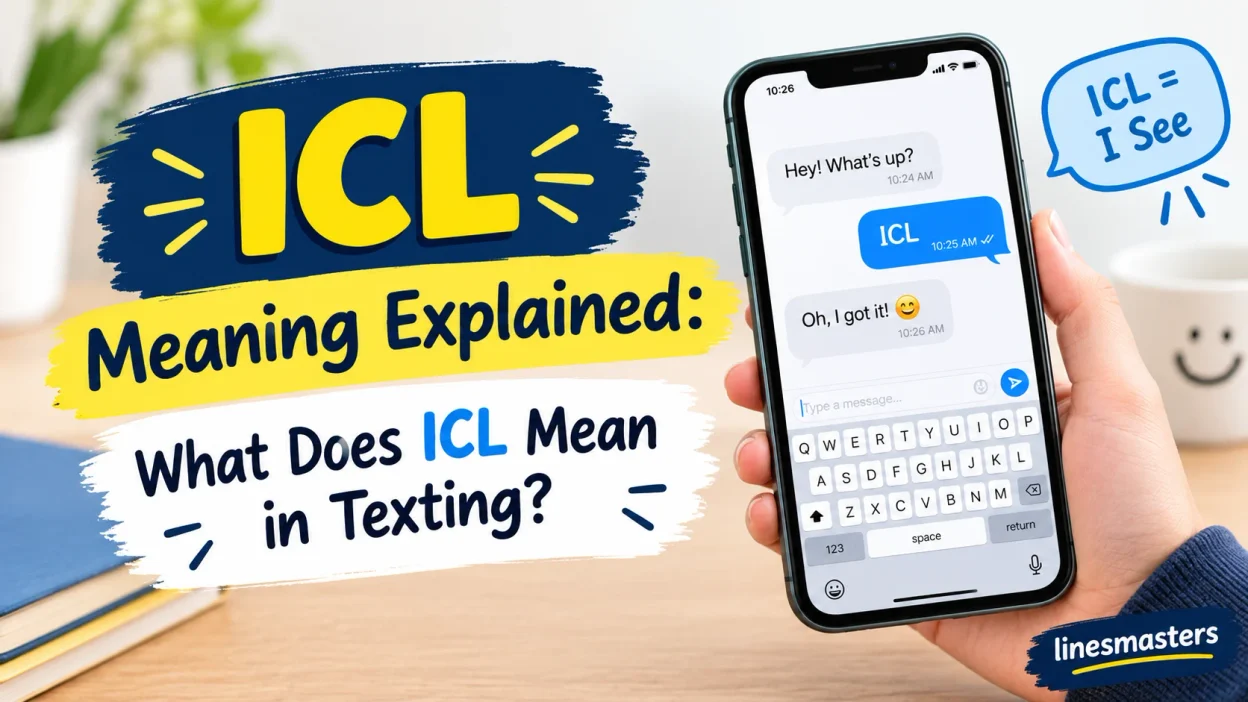
ICL Meaning Explained: What Does ICL Mean in Texting and Social Media? explains how this slang shares honest opinions in chats and online comments.
Have you ever seen ICL in a text message, DM, or social media comment and wondered what it means? You’re not alone. Internet slang changes quickly and evolves fast, so new abbreviations can leave one person confident about the meaning while everyone else is guessing.
The good news is that the common texting meaning of ICL is I Can’t Lie, also written as I Can’t Lie. In online conversations, casual messages, and everyday conversations, people use it to introduce an honest opinion, an admission, or a strong reaction. It can express a genuine reaction, personal admission, compliment, criticism, or feeling. It often works like honestly, to be honest, or I have to admit. Current slang references identify this as the primary internet-slang meaning.
For example, someone might write, “ICL, that movie was actually good.” They are not saying they literally cannot lie; they are signaling that the opinion that follows is meant to sound candid and genuine. Similarly, “ICL, you look amazing” expresses a different emotion from “ICL, I didn’t like the movie.” This small distinction matters because the words around the message help explain its meaning. You may see ICL in social media comments while chatting with friends, scrolling TikTok, or reading Instagram comments. These social platforms are part of modern digital communication. This guide helps break down the real meaning of ICL in texting, explain how people use it, explore alternative meanings, provide clear examples, and help readers avoid misinterpretation.
Quick Answer: What Does ICL Mean?
ICL stands for “I Can’t Lie.” In texting and social media, people use it to introduce an honest opinion, candid reaction, or personal admission.
For example:
Friend: “Did you like the new song?”
You: “ICL, it’s actually really good.”
Here, ICL means something like “Honestly, it’s actually really good.” It signals that the speaker wants to express a sincere opinion.
| Term | Meaning | Common context |
| ICL | I Can’t Lie | Text messages and social media |
| NGL | Not Gonna Lie | Honest opinions and admissions |
| TBH | To Be Honest | Opinions and personal reactions |
| FR | For Real | Agreement and emphasis |
| IDC | I Don’t Care | Indifference or lack of concern |
The key takeaway: If someone uses ICL in a casual conversation, they probably mean “I Can’t Lie.” If you encounter it in a medical report or technical document, check the context before interpreting it.
What Does ICL Mean in Texting?
In texting, ICL works as a short way to introduce something a person genuinely thinks or feels. Instead of typing “I can’t lie” in full, the sender uses three letters to get the point across quickly.
Think of it as a conversational signal. The speaker is essentially saying, “Here’s my honest take.”
For example:
- “ICL, that movie was amazing.”
- “ICL, I completely forgot about the assignment.”
- “ICL, your idea makes a lot of sense.”
- “ICL, I thought the game would be easier.”
Each message uses ICL to introduce a candid thought. The phrase doesn’t change the basic meaning of the sentence. Instead, it adds emphasis and helps establish the speaker’s tone.
Why Do People Use ICL in Text Messages?
Short abbreviations make digital conversations quicker and more casual. ICL also gives people a familiar way to introduce opinions without sounding overly formal.
People commonly use it to:
- Share honest opinions: Explain what they really think about a movie, song, event, or situation.
- Admit mistakes: Acknowledge that they forgot something or misunderstood a situation.
- Emphasize a reaction: Make praise, disappointment, or surprise sound more personal.
- Agree with someone: Reinforce another person’s point of view.
- Start a candid conversation: Prepare the reader for a straightforward response.
For example, “I didn’t expect that ending” communicates surprise. Adding “ICL” at the beginning emphasizes that the reaction is genuine.
Still, ICL doesn’t guarantee that a statement is objectively true. It tells you how the speaker presents the statement, not whether the claim has been verified.
What Does ICL Mean on Social Media?
Social media gives short expressions plenty of room to spread. ICL fits naturally into platforms where people share quick reactions, comment on videos, and respond to friends without writing long messages.
Although its basic meaning stays the same, the way someone uses ICL can depend on the platform and the conversation.
ICL Meaning on TikTok
On TikTok, ICL can appear in video captions, comment sections, and replies. People use it to introduce an opinion about a trend, a song, a creator’s content, or an everyday experience.
For example:
- “ICL, this trend is getting old.”
- “ICL, this song deserves more attention.”
- “ICL, the ending caught me off guard.”
In each example, the abbreviation signals a personal reaction. The words that follow it explain what the person actually thinks.
You might also see ICL in a comment responding to someone else’s opinion. In that case, the abbreviation can add emphasis without requiring a long explanation.
ICL Meaning on Snapchat
Snapchat conversations often rely on short messages and informal language. ICL works well in this setting because it lets people introduce an honest thought in just three letters.
Imagine a friend sends you a picture of a meal they cooked. You might reply:
“ICL, that looks delicious.”
Or, if a friend asks whether you enjoyed a school event, you could say:
“ICL, I thought it would be boring, but I had fun.”
Both messages use ICL to introduce a genuine reaction. Neither requires a special Snapchat-specific definition.
ICL Meaning on Instagram
On Instagram, people may use ICL in comments, direct messages, Stories, and captions.
For example:
- “ICL, this is the best photo in the carousel.”
- “ICL, I need to try that recipe.”
- “ICL, that was a great performance.”
The abbreviation can make a comment feel casual and personal. However, it doesn’t automatically make the message a compliment. A person could use ICL before expressing disappointment or disagreement, too.
ICL Meaning in Gaming and Online Communities
Gaming chats often move quickly, so short expressions help players communicate their reactions without interrupting the conversation.
A player might write:
- “ICL, that was a close match.”
- “ICL, our team played really well.”
- “ICL, I need more practice with this character.”
Here, ICL means “I Can’t Lie,” just as it does in ordinary texting. The gaming context simply determines what the player is talking about.
One important distinction: ICL doesn’t have a universal gaming-specific meaning. If you encounter the letters in a technical discussion about computer hardware or networking, they may refer to something entirely different.
How Is ICL Used in Everyday Conversations?
Understanding the definition is one thing. Recognizing its purpose in a real conversation is what makes the abbreviation easier to interpret.
ICL usually introduces a statement, but the emotion behind that statement can vary. Here are the most common uses.
ICL to Express an Honest Opinion
People often use ICL when they want to share a straightforward opinion about something.
Example:
Friend: “What did you think of the movie?”
You: “ICL, I liked it more than I expected.”
The abbreviation tells your friend that you’re sharing your genuine reaction. It doesn’t mean your opinion is the only correct one.
Other examples include:
- “ICL, that book was better than the movie.”
- “ICL, I prefer the original version.”
- “ICL, the new design looks great.”
ICL to Admit a Mistake
Sometimes, people use ICL before admitting something they’d rather not hide or explain away.
Example:
Friend: “Did you remember to bring the notebook?”
You: “ICL, I forgot it at home.”
The abbreviation makes the admission sound direct and conversational. It doesn’t change the facts of the situation.
You might also see messages such as:
- “ICL, I misunderstood the question.”
- “ICL, I forgot what time we agreed to meet.”
- “ICL, I should’ve checked before replying.”
These examples show how ICL can introduce an admission without making the conversation overly formal.
ICL to Emphasize a Point
ICL can also add emphasis to an opinion the speaker feels strongly about.
For example:
“ICL, that was the best performance of the night.”
The speaker isn’t necessarily confessing anything surprising. They’re emphasizing their judgment and presenting it as a sincere reaction.
This use is common in informal discussions about entertainment, hobbies, sports, and everyday experiences.
ICL to Give a Compliment
A compliment that begins with ICL can sound more personal because the speaker frames it as a candid observation.
For example:
“ICL, you explained that really well.”
Other natural examples include:
- “ICL, your presentation was excellent.”
- “ICL, that song suits your voice.”
- “ICL, you’ve improved a lot at this game.”
The abbreviation doesn’t make a compliment automatically more meaningful. The specific words and the relationship between the people matter more.
ICL to Express Disappointment
Not every honest reaction is positive. ICL can introduce criticism or disappointment when someone wants to state their view directly.
For example:
“ICL, I expected the event to be better organized.”
This message communicates disappointment without attacking a particular person.
Compare it with:
“ICL, nobody knew what they were doing.”
The second statement sounds harsher because it criticizes the people involved. ICL signals candor, but the wording determines how considerate or blunt the message feels.
ICL to Agree With Someone
People sometimes use ICL to reinforce an opinion another person has already expressed.
For example:
Friend: “That was the hardest test we’ve had all year.”
You: “ICL, it really was.”
In this exchange, ICL adds emphasis to the agreement. The actual meaning comes from the rest of the reply.
Real-Life Examples of ICL in Text Messages
The easiest way to understand texting slang is to see how it works in context. These sample conversations demonstrate several common uses of ICL.
| Situation | Example message | What ICL communicates |
| Music | “ICL, this song is stuck in my head.” | A genuine reaction |
| School | “ICL, I found that question difficult.” | An honest admission |
| Food | “ICL, this is the best pizza I’ve tried.” | A strong personal opinion |
| Friendship | “ICL, you were right about that.” | Sincere agreement |
| Entertainment | “ICL, the sequel surprised me.” | A candid reaction |
| Shopping | “ICL, I prefer the cheaper option.” | A personal preference |
| Gaming | “ICL, that was a close match.” | An honest assessment |
| Planning | “ICL, I completely forgot about our plans.” | An admission of forgetfulness |
Example: ICL in a Conversation About a Movie
Alex: “Did you enjoy the movie last night?”
Jordan: “ICL, it was much better than I expected.”
Alex: “Right? The ending was great.”
Jordan uses ICL to introduce an honest opinion. Alex then agrees and adds another observation.
Example: ICL in a Group Chat
Sam: “Who wants to organize the next game night?”
Taylor: “ICL, I’m terrible at planning these things.”
Sam: “No problem. I’ll handle the schedule.”
Taylor uses ICL to admit a weakness in a lighthearted way. The abbreviation doesn’t mean Taylor refuses to help; it simply introduces an honest statement.
Example: ICL in a Disagreement
Riley: “I think the original version was better.”
Morgan: “ICL, I liked the remake more.”
Both people express different opinions without needing to treat the disagreement as an argument. ICL can introduce a personal view, but it doesn’t require the other person to agree.
What these examples teach us: Read the entire message rather than interpreting ICL in isolation. The abbreviation introduces the speaker’s tone, while the surrounding words provide the actual meaning.
ICL Meaning Compared With NGL, TBH, FR, and IDC
ICL belongs to a larger group of internet abbreviations that people use to express opinions, sincerity, agreement, and indifference. These terms sometimes overlap, but they don’t all serve the same purpose.
Understanding the differences helps you choose the right expression and interpret other people’s messages more accurately.
| Abbreviation | Full form | Main purpose | Example |
| ICL | I Can’t Lie | Introduces an honest opinion | “ICL, I enjoyed that.” |
| NGL | Not Gonna Lie | Introduces a candid statement | “NGL, I was nervous.” |
| TBH | To Be Honest | Frames an honest opinion | “TBH, I prefer the first one.” |
| FR | For Real | Shows agreement or emphasizes sincerity | “FR, that was impressive.” |
| IMO | In My Opinion | Identifies a personal viewpoint | “IMO, the first design is better.” |
| IDC | I Don’t Care | Expresses indifference | “IDC which option we choose.” |
ICL vs. NGL: What’s the Difference?
ICL means “I Can’t Lie,” while NGL means “Not Gonna Lie.”
Both expressions introduce honest opinions, personal admissions, or candid reactions. In many conversations, you can use either one without changing the overall message.
For example:
- ICL: “I Can’t Lie, that was a great performance.”
- NGL: “Not Gonna Lie, that was a great performance.”
Both sentences communicate genuine appreciation.
Some speakers may feel that one sounds more natural than the other. However, there’s no universal rule that ICL must sound stronger or softer than NGL. Their tone depends on the speaker, the audience, and the conversation.
ICL vs. TBH: How Are They Different?
TBH stands for “To Be Honest.” Like ICL, it introduces an opinion or statement that the speaker wants to present candidly.
Consider these examples:
- “ICL, I didn’t enjoy the ending.”
- “TBH, I didn’t enjoy the ending.”
The meaning remains almost identical. The difference lies mainly in the wording and personal preference.
TBH can also introduce constructive criticism, personal feedback, or a straightforward assessment. ICL serves similar purposes in casual online conversations.
ICL vs. FR: When Should You Use Each?
FR stands for “For Real.” People use it to express agreement, emphasize sincerity, or show that they genuinely mean something.
For example:
Person A: “That was the best concert I’ve ever attended.”
Person B: “FR, the whole show was incredible.”
Person B uses FR to reinforce agreement.
Compare that with:
“ICL, that was the best concert I’ve ever attended.”
Here, the speaker introduces their own candid opinion.
The expressions can overlap, but ICL more directly introduces an honest statement, while FR often reinforces or confirms one.
ICL vs. IDC: Don’t Confuse Honesty With Indifference
IDC means “I Don’t Care.” Unlike ICL, which introduces an honest statement, IDC communicates that something doesn’t matter to the speaker or that they have no strong preference.
For example:
- ICL: “I Can’t Lie, I prefer the blue design.”
- IDC: “I Don’t Care which design we use.”
The first expresses a preference. The second expresses indifference.
This distinction matters because confusing the abbreviations could completely change the meaning of a message.
Is ICL Positive, Negative, or Neutral?
ICL is neutral by itself. It doesn’t automatically communicate happiness, anger, excitement, or disappointment. The words that follow it establish the message’s emotional tone.
When ICL Sounds Positive
People use ICL to express praise, appreciation, or excitement.
Examples:
- “ICL, you did a fantastic job.”
- “ICL, that was a brilliant idea.”
- “ICL, I’m really enjoying this book.”
In these cases, the abbreviation introduces a favorable opinion.
When ICL Sounds Negative
ICL can also introduce criticism, dissatisfaction, or an unpopular opinion.
Examples:
- “ICL, that explanation wasn’t clear.”
- “ICL, I didn’t enjoy the film.”
- “ICL, the plan needs more work.”
These statements may sound direct, but they aren’t automatically rude. Their impact depends on the situation and the way the speaker expresses the criticism.
When ICL Sounds Neutral
Sometimes, ICL introduces a simple fact or personal admission.
Examples:
- “ICL, I haven’t watched that show.”
- “ICL, I don’t know the answer.”
- “ICL, I forgot what day the event is.”
These messages don’t necessarily praise or criticize anything. They simply present the speaker’s perspective.
Can ICL Sound Rude?
It can, especially when someone uses it before a harsh or unnecessarily personal comment.
Compare these two messages:
More considerate: “ICL, I think we should try a different approach.”
More confrontational: “ICL, your idea makes no sense.”
Both use ICL to introduce an opinion. However, the second message dismisses the other person’s idea without explaining why.
If you want to express an honest opinion without starting an argument, focus on the issue rather than attacking the person.
For example, say, “ICL, I think this plan needs a few changes,” instead of insulting someone’s ability or judgment.
Read More : 301+ Witty Flail Pickup Lines to Win Them Over in 2026
What Does ICL Mean in Other Contexts?
Although “I Can’t Lie” is the common interpretation in casual texting, the same letters appear in medicine and computing history. These meanings aren’t interchangeable, so context matters.
ICL Meaning in Medicine: Implantable Collamer Lens
In eye care, ICL can stand for Implantable Collamer Lens. This is a specialized lens that an eye surgeon places inside the eye to correct certain vision problems.
Unlike a contact lens, which sits on the surface of the eye, an implantable lens sits inside the eye. The natural lens remains in place.
According to the the approved lenses are intended to correct nearsightedness, with a toric version also intended to correct astigmatism in eligible patients. The FDA approved the product on March 25, 2022.
FDA
If you encounter ICL in an eye examination, surgical consultation, or medical article, this may be the intended meaning.
Example: “The ophthalmologist discussed ICL as one possible vision-correction option.”
Here, the acronym refers to a medical lens, not an expression of honesty.
ICL Meaning in Technology: International Computers Limited
In computing history, ICL stands for International Computers Limited, a British computer company formed in 1968 through the merger of established British computing businesses.
The company developed computer systems for business and government customers. Its history forms part of the wider development of Britain’s computing industry.
Fujitsu’s corporate history records that the Japanese technology company took an 80% stake in ICL in November 1990. You can explore the details throughExample: “The article examines ICL’s contribution to the British computer industry.”
In this sentence, the acronym identifies a company rather than a texting expression.
How to Tell Which ICL Meaning Applies
Use the surrounding words to identify the intended meaning.
| Where you see ICL | Likely meaning | Clue to look for |
| A friend’s text message | I Can’t Lie | An opinion or personal reaction |
| A TikTok comment | I Can’t Lie | A reaction to a video or trend |
| An eye clinic’s website | Implantable Collamer Lens | Vision correction or eye surgery |
| A computing history article | International Computers Limited | Computer systems or British technology |
| A specialized technical document | Depends on the field | Definitions and terminology elsewhere in the document |
The basic rule is straightforward: interpret the acronym within its subject area instead of assuming the letters always mean the same thing.
Where Did ICL Slang Come From?
ICL comes from the everyday English phrase “I Can’t Lie.” People have long used similar expressions in conversation to introduce an honest opinion or emphasize that they mean what they say.
The abbreviated form fits naturally into text-based communication, where people often shorten familiar phrases to save time.
How Did ICL Become Part of Internet Slang?
ICL belongs to a broader family of online expressions that signal sincerity. NGL, TBH, and FR serve related purposes, although each has its own wording and conversational uses.
Social media and messaging platforms give people many opportunities to use these short expressions in comments, captions, and private conversations. As readers encounter them repeatedly, the abbreviations can become familiar parts of their online vocabulary.
However, it’s worth separating established meaning from uncertain history. There isn’t enough reliable evidence to identify one person who invented ICL or to establish an exact date when the abbreviation first appeared.
The safest explanation is that ICL abbreviates an existing spoken phrase and became useful in informal digital communication.
How to Use ICL Correctly in a Sentence
Once you understand the ICL meaning, using it naturally is fairly simple. The main thing to remember is that ICL belongs primarily in casual communication.
Put ICL Before an Honest Opinion
This is one of the most common ways to use the abbreviation.
Examples:
- “ICL, this is my favorite episode.”
- “ICL, I expected a better result.”
- “ICL, the new update works well.”
A comma after ICL can make the sentence easier to read, although informal messages don’t always follow standard punctuation.
Use ICL in a Reply
You can also use ICL when responding to a question or joining an existing conversation.
Example:
Friend: “Do you think we should try the new restaurant?”
You: “ICL, I’ve heard great things about it.”
The abbreviation introduces your honest reaction without changing the structure of the conversation.
Can ICL Appear at the End of a Sentence?
Yes. Although people often place ICL at the beginning, informal online usage can put it at the end of a statement.
For example:
- “That movie was surprisingly good, ICL.”
- “I didn’t expect that result, ICL.”
The placement can vary from person to person. The overall meaning usually remains the same.
Should You Use ICL in Professional Writing?
Generally, no. ICL is informal slang, so it may look out of place in a business email, academic assignment, formal report, or application.
Instead of writing:
“ICL, I think this report needs changes.”
You could write:
“To be honest, I think this report needs a few changes.”
Or, in a more professional setting:
“I recommend revising a few sections of this report.”
Choose language that fits your audience. Casual abbreviations work well with friends who understand them, but clear, complete wording is usually better when precision matters.
Common Mistakes to Avoid When Using ICL
A few simple habits can help you use the abbreviation appropriately.
- Don’t assume everyone knows it. Readers who rarely use internet slang may not recognize ICL.
- Don’t confuse it with IDC. ICL introduces an honest statement, while IDC expresses indifference.
- Don’t treat it as proof. Saying “I Can’t Lie” doesn’t establish that a claim is accurate.
- Don’t overuse it. Repeating ICL in every sentence can make a message sound unnatural.
- Don’t assume the tone is always friendly. The rest of the message determines whether it sounds warm, blunt, critical, or neutral.
FAQs:
1. What does ICL mean in texting?
ICL means “I Can’t Lie.” People use it before sharing an honest opinion, personal admission, compliment, or criticism in text messages and online conversations.
2. What does ICL mean on social media?
On social media platforms such as TikTok and Instagram, ICL usually means “I Can’t Lie.” It signals that the person wants to express an honest thought or genuine reaction.
3. How do you use ICL in a sentence?
You can use ICL at the beginning of a sentence to introduce your opinion. For example, “ICL, that movie was actually good” means you genuinely think the movie was good.
4. What is the difference between ICL, NGL, and TBH?
ICL means “I Can’t Lie,” NGL means “Not Gonna Lie,” and TBH means “To Be Honest.” All three abbreviations can introduce an honest opinion in casual conversations.
5. Can ICL have meanings other than “I Can’t Lie”?
Yes. Although “I Can’t Lie” is its common texting meaning, ICL can also stand for Implantable Collamer Lens in medicine and International Computers Limited in computing history. The context helps determine the intended meaning.
Conclusion:
ICL usually means “I Can’t Lie” in texting and social media. People use it to share an honest opinion, express a genuine reaction, or admit how they feel. Its meaning depends on the surrounding conversation, as ICL can also refer to Implantable Collamer Lens in medicine and International Computers Limited in computing history.
Understanding the context helps you interpret the message correctly and use internet slang naturally.



[…] Read More : ICL Meaning Explained: What Does ICL Mean in Texting […]