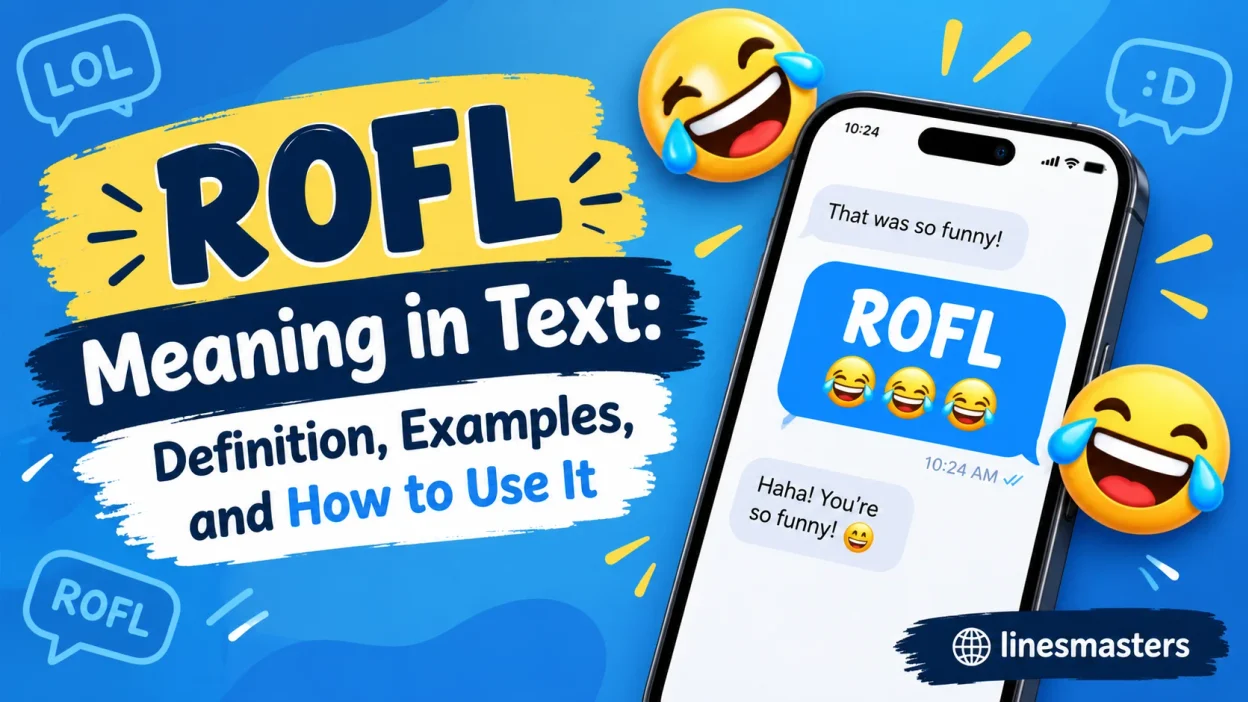
ROFL Meaning in Text: Definition, Examples, and How to Use It explains how this slang shows laughter in chats, messages, and online conversations. ROFL is a popular internet slang abbreviation that stands for “rolling on the floor laughing.” It does not describe an actual fall; instead, it expresses laughter when something is extremely funny. People use it in text messages, social media comments, group chats, online gaming, and online communities. Although the abbreviation may seem unusual or confusing at first, its simple meaning is easy to understand. It adds emotion without requiring a long explanation.
When someone replies with ROFL, they are telling you that a message, funny joke, surprising comment, meme, video, or embarrassing moment made them laugh extremely hard. Its meaning can depend on the context and tone, which affect how a conversation comes across. Understanding ROFL helps people read messages correctly, recognize playful reactions, follow online conversations, respond naturally, and avoid awkward replies instead of guessing what someone means. In everyday texting, ROFL often communicates a stronger reaction than LOL. People may also combine it with other expressions, such as LMAO and LMFAO, to communicate amusement in casual chats and gaming conversations.
To learn the origin, definition, and practical use of ROFL, consider common situations. For example, after a friend shares a hilarious joke, you might say, “ROFL, that was so funny!” You could also reply, “ROFL, I can’t believe that happened!” These practical examples show how the term communicates emotion naturally. For best results, use ROFL when something genuinely seems funny and match its tone to the discussion. This guide helps you understand the ROFL meaning in text in 2026, compare it with common internet expressions, and make online communication easier.
Quick Answer: What Does ROFL Mean in Text?
ROFL stands for “Rolling on the Floor Laughing.” It’s an informal internet abbreviation that people use to show that something is extremely funny.
For example:
- Friend: “I walked into the wrong classroom and sat there for ten minutes.”
- You: “ROFL 😂”
In this conversation, ROFL tells your friend that you find the situation hilarious. The phrase is usually figurative, so the person doesn’t necessarily mean they’re literally rolling on the floor.
What Does ROFL Stand For?
ROFL is an acronym formed from the first letters of four words: Rolling On the Floor Laughing. Each word contributes to an exaggerated image of someone laughing so hard that they can barely stay upright.
Here’s how the abbreviation breaks down:
- R — Rolling: Suggests moving around because the laughter feels overwhelming.
- O — On: Connects the action to its location.
- F — Floor: Creates the image of someone laughing uncontrollably.
- L — Laughing: Describes the reaction that prompted the expression.
Together, these words communicate a strong reaction to something funny. People don’t need to type the complete phrase every time they want to express amusement. The abbreviation conveys the idea in just four letters.
Is ROFL Meant to Be Taken Literally?
Usually, no. ROFL is a figurative expression rather than a literal description of someone’s physical behavior.
Imagine your friend shares a video of a cat trying to jump onto a couch but landing in a laundry basket instead. You might respond with “ROFL” even if you’re simply smiling at your phone.
The abbreviation emphasizes your reaction, not what your body is physically doing.
Example:
“Your presentation slides had a picture of a potato labeled ‘Chief Technology Officer.’ ROFL!”
Here, ROFL tells the recipient that the joke amused you. It doesn’t mean you actually fell onto the floor.
ROFL vs. ROTFL: What’s the Difference?
ROFL and ROTFL have the same basic meaning. The second version includes an extra T to represent the word “the.”
| Abbreviation | Full form | Meaning |
| ROFL | Rolling on the floor laughing | Expresses strong amusement |
| ROTFL | Rolling on the floor laughing | Expresses strong amusement |
What Does ROFL Mean in Texting?
In text messages, ROFL generally means that the sender finds something very funny. It can communicate amusement, playful disbelief, or an exaggerated response to an entertaining situation.
Because text messages lack facial expressions and vocal tone, abbreviations help people communicate feelings quickly. ROFL provides a written signal that the sender is laughing or reacting enthusiastically.
However, the exact meaning depends on the conversation.
ROFL as a Reaction to Something Funny
The most common interpretation is straightforward: someone said or shared something that made the recipient laugh.
Example:
- Alex: “My brother tried to make pancakes and accidentally used salt instead of sugar.”
- Jamie: “ROFL 😂”
Jamie uses ROFL to show that Alex’s story sounds hilarious.
ROFL to Express Surprise or Disbelief
Sometimes, ROFL communicates amusement at something unexpected rather than a traditional joke.
Example:
- Sam: “He wore two different shoes to school and didn’t notice until lunchtime.”
- Taylor: “ROFL, how does that even happen?”
Taylor finds the situation funny and seems surprised by it.
ROFL in Playful Conversations
Friends sometimes use ROFL to react to teasing, silly mistakes, or shared jokes. In these situations, the abbreviation can make a conversation feel more relaxed.
For example, if someone accidentally sends a message full of autocorrect errors, a friend might reply, “ROFL, what were you trying to say?”
That response can feel friendly when both people understand the joke. Still, laughing at someone else’s mistake can come across as unkind if the recipient feels embarrassed.
The key takeaway: ROFL usually signals strong amusement, but the surrounding messages help you understand whether the laughter feels friendly, surprised, sarcastic, or insensitive.
How to Use ROFL in a Sentence
You can use ROFL in several ways, depending on your conversation and how strongly you want to express amusement. It works as a complete response, as part of a sentence, or alongside an emoji.
ROFL as a Standalone Response
A standalone response works well when the other person has already shared something funny.
Examples:
- “ROFL!”
- “ROFL 😂”
- “ROFL, that’s hilarious.”
- “I’m ROFL right now.”
The last example uses ROFL as a verb-like expression. Although people may understand this informal construction, a more standard alternative is “I’m laughing so hard right now.”
ROFL in a Full Sentence
Adding ROFL to a complete sentence gives your reaction more context. It can help you explain what you found funny.
Examples:
- “ROFL, that ending was completely unexpected.”
- “I read your message during lunch and started laughing. ROFL!”
- “That impression was so accurate. ROFL.”
- “ROFL, your dog really stole the whole sandwich.”
These examples show that ROFL doesn’t need a fixed position. You can place it at the beginning or end of a casual message.
ROFL With Emojis
Emojis can reinforce the emotion behind an abbreviation. A laughing emoji, for example, makes the humorous intent easier to recognize.
| Message | Likely tone |
| “ROFL 😂” | Strong amusement |
| “ROFL 💀” | Exaggerated laughter or an internet-style reaction |
| “ROFL 😭” | Overwhelming laughter, depending on context |
| “rofl lol” | Informal, playful emphasis |
These interpretations aren’t universal rules. Emoji meanings change across communities, and some people use them ironically.
A simple “ROFL” can communicate the same basic idea without any emoji. Choose the version that feels natural for the conversation rather than adding symbols just to make the message look more expressive.
ROFL vs. LOL vs. LMAO: What’s the Difference?
ROFL, LOL, and LMAO all express amusement, but they use different phrases to convey it. Understanding these distinctions helps you choose an abbreviation that fits your message.
| Slang | Full form | Typical use |
| ROFL | Rolling on the floor laughing | Exaggerated laughter |
| LOL | Laughing out loud | General amusement or a lighthearted reaction |
| LMAO | Laughing my ass off | Strong, informal amusement |
| ROTFL | Rolling on the floor laughing | Same meaning as ROFL |
| ROFLMAO | Rolling on the floor laughing my ass off | An intensified, humorous reaction |
The descriptions above reflect common usage rather than a strict ranking. One person might use LOL for a genuinely funny joke, while another might reserve it for a mild chuckle.
ROFL vs. LOL
LOL is short for “laughing out loud.” It’s a versatile abbreviation that people use in many casual conversations.
For example:
- Friend: “I forgot why I walked into the kitchen.”
- You: “LOL, that happens to me all the time.”
ROFL generally paints a more exaggerated picture of laughter. LOL can express anything from mild amusement to genuine laughter.
ROFL vs. LMAO
LMAO stands for “laughing my ass off.” It conveys strong amusement and uses informal language that includes mild profanity.
For example:
- Friend: “My little cousin thinks the moon follows our car.”
- You: “LMAO, that’s actually adorable.”
ROFL and LMAO often serve the same purpose. The difference lies mainly in their wording and the tone the sender wants to convey.
What Does ROFLMAO Mean?
ROFLMAO combines ROFL with LMAO. It expands to “rolling on the floor laughing my ass off.”
People use it to exaggerate a humorous reaction, often when a joke or situation strikes them as especially funny. Like ROFL, it usually describes an emotional reaction rather than a literal physical action.
Remember: These abbreviations don’t have an official scale of laughter. The sender’s habits and the conversation matter more than the number of letters.
Where Do People Use ROFL?
ROFL appears in different forms of digital communication. Although its meaning stays broadly consistent, the setting can affect how naturally it fits a conversation.
ROFL in Text Messages
Text messages are one of the simplest places to use ROFL. Friends might send it after sharing funny stories, jokes, embarrassing moments, or amusing pictures.
For example:
“Remember when we spent ten minutes looking for your phone while you were holding it? ROFL!”
The abbreviation adds a playful reaction to a shared memory.
ROFL on Social Media
On social media, people may use ROFL in comments, replies, captions, and conversations about entertaining posts.
For example:
- Someone posts a funny video of their pet.
- A viewer comments, “ROFL, the dog’s expression at the end!”
- Other viewers understand that the comment expresses amusement.
ROFL can also appear in discussions about memes and humorous situations. However, it doesn’t automatically mean that the person agrees with the original post or endorses everything it contains.
ROFL in Online Gaming and Group Chats
Gaming conversations often move quickly, so short expressions can make reactions easier to send. Players might use ROFL after a teammate makes an unexpected mistake or someone tells a funny story during a match.
Group chats work similarly. A single ROFL message can acknowledge a joke without requiring a long response.
The main consideration is familiarity. In a casual group that regularly uses internet slang, ROFL may feel natural. In a more formal community, a straightforward response might work better.
Is ROFL Still Used Today?
However, recognition doesn’t necessarily mean that everyone uses it regularly.
Some people prefer LOL, LMAO, laughing emojis, or newer expressions they encounter in their online communities. Others continue using ROFL because it feels familiar or communicates an exaggerated reaction.
There isn’t one universally preferred abbreviation for every age group or platform. Individual habits, social circles, and conversational styles all play a role.
Practical tip: If someone sends you ROFL, you don’t need to know every internet slang trend to understand the message. In most situations, they’re simply telling you that they found something funny.
Read More : SYD Meaning in Text: Definitions, Examples, and How to Reply
When Should You Use ROFL?
ROFL works best when the conversation is informal and the other person can reasonably interpret it as a humorous reaction.
Situations Where ROFL Fits Naturally
Consider using ROFL when:
- A friend shares a genuinely funny story.
- Someone sends you a humorous meme or video.
- You’re joking around in a group chat.
- A shared experience reminds you of something ridiculous.
- You want to react quickly without typing a full sentence.
For example, if your friend sends a picture of their cat sitting inside an empty cereal box, “ROFL, your cat has claimed the packaging” could be a playful response.
When to Avoid Using ROFL
ROFL doesn’t suit every situation. Consider the other person’s feelings and the tone of the conversation before sending it.
Avoid using it when:
- Someone shares upsetting personal news.
- A person feels embarrassed about a mistake.
- You’re responding to a serious complaint.
- You’re writing a formal email or professional report.
- Your joke might make another person feel targeted or excluded.
Imagine a classmate tells you they’re worried about an upcoming presentation. Replying with ROFL could seem dismissive unless you’re responding to an obviously humorous part of the conversation.
A direct, thoughtful response usually works better when someone needs support.
How to Reply When Someone Texts ROFL
You don’t need to respond with another abbreviation every time someone sends ROFL. Your reply should fit the conversation.
If Someone Finds Your Joke Funny
You can acknowledge their reaction and keep the conversation going.
Examples:
- “I knew you’d laugh at that!”
- “That was even funnier in person.”
- “Wait until you hear what happened next.”
- “I couldn’t keep a straight face either.”
If You Don’t Understand the Joke
It’s perfectly fine to ask for clarification rather than pretending you understand.
Examples:
- “Wait, what part was the funniest?”
- “I think I’m missing something. Explain!”
- “How did that happen?”
A friendly question can clear up confusion without making the conversation awkward.
If ROFL Seems Sarcastic
Sometimes, people use laughter expressions ironically. They might respond with ROFL to suggest that something sounds ridiculous rather than genuinely funny.
For instance, someone might write, “ROFL, you really think that excuse will work?”
The wording could signal sarcasm, but the abbreviation alone doesn’t prove it. Look at the preceding messages and consider how the person usually communicates.
If you’re unsure, ask what they mean instead of assuming they’re mocking you.
Common Misunderstandings About ROFL
Although ROFL has a straightforward definition, readers can misinterpret its tone.
Here are some common mistakes to avoid:
- Assuming literal laughter: The sender doesn’t need to be physically rolling on the floor.
- Treating ROFL and LOL as identical in tone: Both communicate amusement, but ROFL often suggests a more exaggerated reaction.
- Assuming ROFL always indicates sarcasm: It can be sarcastic, but genuine amusement is its ordinary meaning.
- Believing capitalization changes the definition: ROFL, rofl, and Rofl generally communicate the same thing.
- Using ROFL in every conversation: Informal slang works best when it matches the audience and situation.
Understanding these distinctions makes it easier to interpret messages without reading too much into a few letters.
FAQs:
1. What does ROFL mean in text?
ROFL stands for “rolling on the floor laughing.” People use it in text messages and online conversations to show that something is extremely funny.
2. Is ROFL stronger than LOL?
Yes, ROFL generally expresses a stronger reaction to something funny than LOL, which means “laughing out loud.” However, the meaning can depend on the conversation and the person using it.
3. How do you use ROFL in a text message?
You can use ROFL after a funny joke, meme, video, or surprising comment. For example, “ROFL, that joke was hilarious!” shows that you found something very funny.
4. What is the difference between ROFL, LMAO, and LMFAO?
ROFL means “rolling on the floor laughing,” LMAO means “laughing my ass off,” and LMFAO means “laughing my freaking ass off” or the more explicit version of that phrase. All three express strong amusement, but their tone and intensity can vary.
5. Is ROFL still used in 2026?
Yes, ROFL is still recognizable internet slang in 2026. You may encounter it in text messages, social media comments, gaming chats, and casual online discussions, although usage varies by person and platform.
Conclusion:
Understanding ROFL meaning in text makes online conversations easier and helps you recognize when someone finds something extremely funny. ROFL stands for “rolling on the floor laughing” and is commonly used in text messages, social media comments, group chats, and online gaming conversations.
You can use it after a funny joke, meme, or surprising comment to express laughter naturally. Remember to consider the tone and context before using internet slang so your message comes across as intended.