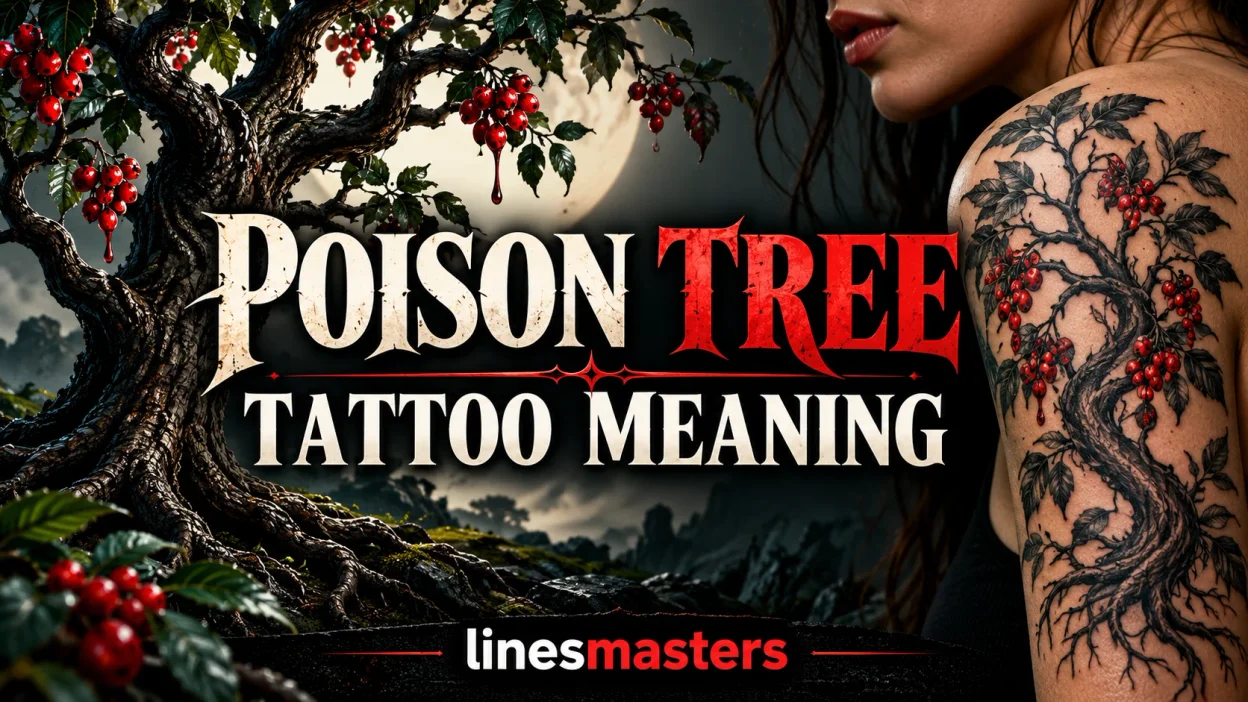
Poison Tree Tattoo Meaning: Symbolism, Origins, and Design Ideas explores anger, betrayal, hidden feelings, and the dark beauty of a symbolic tree.
A poison tree tattoo gives a familiar tree a darker meaning. Unlike a typical tree tattoo, which often represents life, family, strength, growth, new beginnings, strong roots, and fresh leaves, this design explores anger, betrayal, temptation, resentment, revenge, and danger. Its twisted black tree, dark branches, exposed roots, delicate branches, and thorns create a dark botanical appearance. A single red apple or poisonous fruit can become a powerful metaphor for beautiful things hiding darker truths. This striking design turns a peaceful image into a meaningful tattoo with unusual emotional depth, dark symbolism, and a personal message.
The literary connection comes from William Blake, a famous poet whose poem A Poison Tree was published in 1794 in Songs of Experience. The poem describes anger that grows quietly when a person chooses hiding anger instead of addressing anger and addressing emotions. Over time, hidden anger, suppressed anger, and hidden feelings can develop into bitterness, emotional conflict, and emotional struggle.This literary symbolism, literary inspiration, and literary meaning give the tattoo symbolism a deeper emotional meaning. Even without being a Blake scholar, anyone with a love of literature can appreciate the origins and story behind this tattoo.
From a design perspective, I find that the strongest tattoo design is one that connects the image to a real personal experience. For some people, a tree tattoo represents a painful experience, painful experiences, or a painful chapter involving a toxic relationship or toxic relationships. For others, it reflects personal growth, painful growth, emotional growth, emotional awareness, emotional expression, emotional healing, and emotional survival.
Quick Answer: What Does a Poison Tree Tattoo Mean?
A poison tree tattoo symbolizes suppressed anger, resentment, betrayal, temptation, revenge, and the consequences of hidden emotions. Its meaning comes largely from William Blake’s poem A Poison Tree, which explores how unexpressed anger can grow into something destructive.
However, the tattoo doesn’t always represent negativity. Some people choose it to symbolize emotional awareness, personal growth, lessons learned, or the strength to recognize harmful patterns.
| Symbol | Common Meaning |
| Poison tree | Hidden anger and emotional consequences |
| Poisonous apple | Temptation, deception, and destructive choices |
| Deep roots | Buried emotions and unresolved experiences |
| Twisted branches | Inner conflict and complicated feelings |
| Dead leaves | Loss, change, or emotional exhaustion |
| New growth | Healing and personal transformation |
| Thorns | Pain, boundaries, and emotional protection |
Ultimately, the wearer’s personal experience determines the tattoo’s deeper meaning.
What Does a Poison Tree Tattoo Symbolize?
The poison tree tattoo represents the complicated relationship between emotions and consequences. Its central message is that feelings don’t simply disappear when someone refuses to acknowledge them. Instead, they can influence decisions, relationships, and behavior over time.
The tree provides a visual metaphor for this process. Its roots represent what lies beneath the surface. Its trunk reflects accumulated experiences, while its branches show how emotions spread into different parts of life.
Here are the most common interpretations.
Suppressed Anger and Hidden Resentment
Anger is one of the strongest meanings associated with a poison tree tattoo. The design reflects what can happen when someone keeps frustration, disappointment, or resentment buried for too long.
Rather than expressing difficult feelings, a person may allow them to grow silently. Over time, those emotions can affect trust, communication, and relationships.
A poison tree tattoo can represent:
- Anger that remained unspoken.
- Resentment caused by unresolved conflict.
- The emotional weight of keeping feelings hidden.
- Awareness of destructive emotional patterns.
- The importance of addressing problems honestly.
For someone who has experienced this situation, the tattoo can serve as a reminder to recognize emotions before they begin shaping harmful choices.
Betrayal and Broken Trust
A poison tree tattoo can also represent betrayal. Its attractive appearance and dangerous fruit create a powerful contrast between what something seems to be and what it actually becomes.
This interpretation often connects with experiences involving dishonesty, broken promises, or damaged relationships.
The tree may represent trust that once seemed strong. Its poisonous fruit reflects the consequences of deception.
For example, someone who experienced a difficult friendship might choose a poison tree with a single apple to represent the difference between appearances and reality.
The tattoo doesn’t need to communicate bitterness. It can simply mark a moment when someone learned to recognize unhealthy relationships and value honesty.
Revenge and Its Consequences
Revenge is another important part of the poison tree’s symbolism.
In Blake’s poem, the speaker allows anger toward an enemy to grow rather than resolving it. The resulting fruit becomes an image of the destructive consequences of nurtured resentment.
A poison tree tattoo can therefore represent:
- The temptation to retaliate.
- The emotional cost of holding grudges.
- The difference between justice and revenge.
- Lessons learned from past conflicts.
- A decision not to let resentment control the future.
This interpretation makes the design more reflective than aggressive. Instead of celebrating revenge, it can remind the wearer why destructive emotional cycles deserve attention.
Hidden Pain Behind a Beautiful Exterior
One of the most striking aspects of a poison tree tattoo is its contrast between beauty and danger.
A tree can look elegant, peaceful, and full of life while hiding poisonous fruit. This imagery reflects the difference between someone’s outward appearance and their private emotional experiences.
A person might appear calm and confident while carrying disappointment, grief, or unresolved conflict.
The tattoo can symbolize:
- Private struggles that others don’t see.
- Emotional complexity.
- The difference between appearance and reality.
- Strength developed through difficult experiences.
- The importance of looking beyond surface impressions.
This meaning works particularly well with fine-line designs featuring delicate branches and one dark or brightly colored apple.
Temptation and Forbidden Desires
The poisonous apple also connects the tattoo to temptation.
Apples carry several cultural associations, including knowledge, desire, and forbidden choices. In Christian tradition, the fruit in the Garden of Eden is commonly associated with temptation and disobedience, although the biblical text doesn’t identify it specifically as an apple.
When combined with a poison tree, the fruit can represent something attractive that carries hidden consequences.
This interpretation may relate to:
- Choices that initially seemed harmless.
- Desires that conflicted with personal values.
- The appeal of forbidden experiences.
- The consequences of ignoring warning signs.
The symbolism becomes especially clear when the artist places one bright apple against a dark tree.
Personal Growth and Emotional Awareness
Although the poison tree tattoo often carries dark associations, it can also represent personal growth.
Recognizing harmful patterns is an important part of changing them. A tattoo inspired by the poison tree can mark the moment someone began understanding their emotions rather than allowing them to control their decisions.
For example, a tree with a few fresh leaves among dark branches might represent growth after a difficult chapter.
This interpretation emphasizes awareness, accountability, and the ability to make different choices.
The Story Behind the Poison Tree Tattoo: William Blake’s Poem
The most important literary influence behind the poison tree tattoo is William Blake’s poem A Poison Tree.
Blake published the poem in 1794 as part of Songs of Experience, a collection that explores darker aspects of human nature, social conditions, innocence, and experience.
The poem presents a simple but unsettling idea: anger can become more destructive when someone deliberately feeds it instead of addressing it.
What Is William Blake’s A Poison Tree About?
The poem contrasts two situations involving anger.
In the first, the speaker expresses anger toward a friend. The conflict ends because the feelings come into the open.
In the second, the speaker hides anger toward an enemy. Rather than resolving the conflict, the speaker allows resentment to grow through fear, deception, and emotional concealment.
Eventually, that resentment produces a poisonous apple.
The enemy encounters the fruit, and the poem ends with a disturbing consequence.
The tree functions as an extended metaphor for the way hidden anger develops and produces destructive results.
Why Does the Poem Matter to Poison Tree Tattoo Meaning?
The poem gives the tattoo a clear symbolic foundation.
Each part of the tree can represent a stage in the growth of resentment:
| Part of the Poem | Tattoo Interpretation |
| Hidden anger | Roots beneath the surface |
| Nurtured resentment | Growing trunk and branches |
| Deception and concealment | Dark leaves or twisted limbs |
| Poisonous apple | Temptation and consequences |
| Final outcome | The destructive potential of unresolved conflict |
This connection makes the poison tree different from an ordinary dark tree tattoo.
Its symbolism isn’t simply about sadness or danger. It explores how emotions can develop into actions and how those actions affect others.
The Literary Meaning Versus Personal Interpretation
Blake’s poem focuses on anger, resentment, and destructive consequences. Modern tattoo interpretations can extend beyond those themes.
Someone may choose the design because they appreciate poetry, while another person may connect it with betrayal or personal transformation.
Both interpretations can work.
However, understanding the original poem gives the tattoo more depth and prevents its meaning from becoming a vague symbol of darkness.
Poison Tree Tattoo Design Elements and Their Meanings
The small details in a poison tree tattoo can change its entire message. A single apple creates a different impression from a tree covered in thorns or one with exposed roots.
Understanding these elements helps you recognize the symbolism behind different designs.
Poison Tree With Deep Roots
Roots often represent the hidden foundations of a person’s experiences.
In a poison tree tattoo, exposed roots can symbolize buried anger, unresolved conflict, family history, or emotional patterns that developed over time.
A design with long, tangled roots can communicate that the problem extends deeper than what appears on the surface.
Common meanings:
- Buried emotions.
- Deep personal history.
- Unresolved experiences.
- The origins of resentment.
- Understanding where harmful patterns begin.
Poisonous Apple Tattoo Meaning
The apple is arguably the most recognizable element in the poison tree design.
Its meaning comes directly from Blake’s poem, where the fruit represents the outcome of carefully nurtured anger.
A single red apple can symbolize temptation, deception, revenge, or a choice with unexpected consequences.
Some designs feature a bright apple hanging from an otherwise black tree. This creates a visual focal point and makes the contrast between beauty and danger immediately clear.
Dead Branches and Withered Leaves
Dead branches create a darker interpretation of the poison tree tattoo.
They may represent emotional exhaustion, damaged relationships, loss, or the aftermath of destructive choices.
Withered leaves can also symbolize the end of a difficult period.
The exact meaning depends on the composition. A completely dead tree may communicate loss, while a tree with a few fresh leaves can suggest change or renewal.
Twisted Branches and Thorns
Twisted branches create a sense of tension and complexity.
They can represent complicated emotions, difficult experiences, or the way unresolved resentment affects someone’s outlook.
Thorns add another layer of meaning. They may suggest pain, emotional defenses, or boundaries developed after betrayal.
These details work particularly well in gothic and blackwork designs.
Snakes, Birds, and Other Symbols
Some poison tree tattoos include additional imagery to create a more personal message.
| Added Element | Possible Interpretation |
| Snake | Temptation, transformation, or biblical symbolism |
| Raven | Mystery, darkness, or reflection |
| Fallen leaves | Change, loss, or transition |
| Skull | Mortality and consequences |
| Crescent moon | Secrecy, nighttime, or introspection |
| Broken heart | Betrayal and emotional wounds |
These meanings aren’t universal. The surrounding artwork and personal intention determine how the elements work together.
Popular Poison Tree Tattoo Styles
The artistic style influences how people interpret the tattoo before they even know its story.
A realistic tree can feel grounded and natural, while a gothic illustration may emphasize mystery and emotional darkness.
Blackwork Poison Tree Tattoo
Blackwork uses solid black areas, strong outlines, and contrast to create dramatic designs.
For poison tree tattoos, this style works particularly well with:
- Twisted branches.
- Exposed roots.
- Dark silhouettes.
- Sharp thorns.
- A contrasting apple.
Fine-Line Poison Tree Tattoo
Fine-line tattoos use delicate outlines and subtle details.
A fine-line poison tree can feature thin branches, small leaves, and a single apple. The result feels understated while retaining its literary meaning.
This style suits people who prefer botanical artwork over a heavily shaded composition.
However, very small details may become less distinct as a tattoo ages. An experienced artist can help simplify the design while preserving its important features.
Gothic Poison Tree Tattoo
Gothic poison tree tattoos often feature dramatic silhouettes, twisted limbs, dark shading, and sometimes skulls or other symbolic elements.
Their visual language supports themes of secrecy, temptation, mortality, and emotional conflict.
Some designs resemble illustrations from old poetry books, which makes them particularly suitable for people drawn to Blake’s literary influence.
Minimalist Poison Tree Tattoo
Minimalist designs reduce the tree to its most recognizable features.
A small silhouette, one branch, or a single apple can communicate the idea without elaborate shading.
The strongest minimalist designs usually focus on one central symbol rather than squeezing too many details into a limited space.
Realistic Poison Tree Tattoo
Realistic designs emphasize natural textures, bark, roots, branches, and fruit.
They can make the tree look almost lifelike while using darker elements to communicate its symbolic meaning.
A realistic poison tree works particularly well as a larger composition where the artist has enough room to distinguish the individual details.
Illustrative Poison Tree Tattoo
Illustrative designs draw inspiration from botanical drawings, vintage prints, and literary artwork.
They can include decorative borders, handwritten text, or an antique appearance.
For someone who appreciates William Blake, this style offers a direct connection between literature and tattoo art.
Poison Tree Tattoo Ideas and Their Meanings
Different combinations create different interpretations. The following designs offer useful starting points for understanding the symbolism.
Poison Tree With a Single Red Apple
A black tree with one red apple creates a strong visual contrast.
The apple becomes the focal point, drawing attention to temptation, hidden danger, and the consequences of resentment.
This design is especially suitable for someone who wants the literary connection to remain recognizable.
Poison Tree With Exposed Roots
An exposed-root design emphasizes the source of emotional conflict.
The roots can represent buried feelings, personal history, and experiences that continue influencing present decisions.
It works well as a vertical composition with the roots spreading beneath the trunk.
Poison Tree With Falling Leaves
Falling leaves introduce the idea of change.
Depending on the design, they can represent loss, the end of a difficult chapter, or the gradual process of moving forward.
A mixture of bare branches and fresh leaves creates a more hopeful interpretation than a completely lifeless tree.
Poison Tree With a Skull
A skull adds themes of mortality and consequences.
Combined with the tree, it can represent the destructive potential of revenge or the lasting impact of harmful choices.
This combination usually creates a darker gothic design.
Poison Tree With a Broken Heart
A broken heart connects the tree’s symbolism to betrayal and damaged trust.
The tree may represent a relationship or emotional experience, while the heart communicates the personal impact.
This design can be meaningful without suggesting that the wearer remains defined by the experience.
Poison Tree With a Crescent Moon
A crescent moon adds atmosphere and a sense of mystery.
Placed above twisted branches, it creates a nighttime composition associated with secrecy, reflection, and hidden emotions.
The moon doesn’t have one fixed meaning in this combination. Its role depends on the overall design.
Poison Tree With a Quote
A short literary quotation can make the tattoo’s inspiration more obvious.
William Blake’s A Poison Tree offers a natural connection, although the selected wording should be checked against a reliable edition before tattooing.
Another option is to use a short original phrase that captures the intended message without directly quoting the poem.
Poison Tree Tattoo Placement and Its Meaning
Placement affects the tattoo’s visibility, proportions, and available detail. It doesn’t have a universal psychological meaning.
A vertical tree needs enough room for its branches and roots, while a small apple design can fit into a more compact area.
Forearm Poison Tree Tattoo
The forearm provides a naturally vertical canvas for a tree.
It works well for fine-line branches, a central trunk, and visible roots. Depending on the design, the tattoo can remain easy to see or sit on the inner forearm for a more personal feel.
Upper Arm Poison Tree Tattoo
The upper arm offers room for a detailed composition.
Artists can incorporate twisted branches, fruit, and surrounding elements without crowding the design.
It also allows flexibility in how much of the tattoo remains visible.
Back Poison Tree Tattoo
The back accommodates larger artwork with extensive roots and branches.
A detailed illustrative design can spread across the available space while preserving the tree’s natural proportions.
This placement is particularly useful when the concept includes several symbolic elements.
Shoulder Poison Tree Tattoo
The shoulder works well for a tree whose branches follow the body’s natural curves.
A smaller design can focus on the trunk and fruit, while a larger composition can extend toward the upper arm or back.
Calf Poison Tree Tattoo
The calf offers a vertical area suited to a narrow tree silhouette.
It can accommodate fine-line artwork, blackwork, or a design with roots extending toward the ankle.
Wrist or Ankle Poison Tree Tattoo
These placements generally work better for simplified designs.
A small apple, a short branch, or a compact tree silhouette can preserve the central symbolism without relying on tiny details.
What Does a Poison Tree Tattoo Mean for Different People?
The same tattoo can tell very different stories depending on the person wearing it.
Its symbolism becomes more meaningful when connected to a specific experience rather than a generic definition.
For Someone Who Has Experienced Betrayal
A poison tree can represent the moment someone realized that trust and appearances don’t always match.
For example, a person who experienced dishonesty in a close friendship might choose a tree with one poisonous apple.
The design can symbolize the lesson learned rather than the person who caused the hurt.
For Someone Reflecting on Anger
The tattoo may represent an understanding of how unresolved emotions affect decisions.
A tree with tangled roots can serve as a visual reminder to recognize difficult feelings instead of allowing them to grow unnoticed.
Its meaning centers on awareness rather than aggression.
For Someone Who Loves Dark Literature
For literature enthusiasts, the tattoo can represent an appreciation for William Blake’s poetic style and psychological themes.
The connection is particularly strong when the design includes an apple or an illustrative composition inspired by older book artwork.
For Someone Focused on Personal Growth
A poison tree can represent learning from past experiences.
A design with fresh leaves, a changing tree, or a mixture of living and dead branches can express the idea that difficult experiences don’t have to determine what happens next.
Is a Poison Tree Tattoo Good or Bad?
A poison tree tattoo isn’t inherently good or bad.
Its traditional literary associations lean toward darker themes because Blake’s poem explores hidden anger, deception, and destructive consequences.
However, the tattoo can also communicate self-awareness, emotional maturity, and personal transformation.
Consider these interpretations:
| Darker Interpretation | Reflective Interpretation |
| Resentment | Emotional awareness |
| Revenge | Learning from conflict |
| Betrayal | Recognizing unhealthy patterns |
| Temptation | Understanding consequences |
| Hidden pain | Accepting personal experiences |
| Destruction | Change and renewal |
The difference often comes down to the artwork.
A completely black tree with a poisonous apple may emphasize danger and resentment. A tree with new leaves may suggest growth after a difficult period.
Neither interpretation is automatically more authentic than the other.
Read More : Fyrtrd Meaning: What Does Fyrtrd Really Mean?
Poison Tree Tattoo vs. Tree of Life Tattoo
Although both designs use a tree to communicate deeper ideas, their central themes differ.
| Feature | Poison Tree Tattoo | Tree of Life Tattoo |
| Main symbolism | Resentment and consequences | Growth and connection |
| Common imagery | Twisted branches and poisonous fruit | Strong trunk and spreading branches |
| Emotional tone | Dark and reflective | Often hopeful and balanced |
| Common themes | Temptation, betrayal, hidden emotions | Renewal, continuity, interconnectedness |
| Literary connection | William Blake’s poem | Various cultural and spiritual traditions |
The poison tree focuses on the consequences of emotional patterns and choices.
The tree of life more commonly represents the relationship between growth, existence, and connection.
Both can carry personal meaning, but they communicate different ideas.
Things to Consider Before Choosing a Poison Tree Tattoo
A poison tree tattoo often contains several layers of symbolism. Before settling on a design, consider what you actually want it to communicate.
Think about these points:
- Choose your central meaning: Decide whether the tattoo represents literature, betrayal, anger, temptation, or personal growth.
- Select meaningful details: An apple, exposed roots, or fresh leaves can change the message considerably.
- Match the style to the concept: Blackwork emphasizes contrast, while fine-line artwork creates a subtler appearance.
- Consider the available space: Detailed branches and roots need enough room to remain clear.
- Think about long-term readability: Extremely small details may become less distinct over time.
- Discuss the design with a qualified tattoo artist: A professional can help translate the symbolism into a balanced composition.
Most importantly, avoid choosing extra symbols simply because they look attractive. A focused design often communicates more than one crowded with unrelated details.
FAQs:
1. What does a poison tree tattoo mean?
A poison tree tattoo often represents anger, resentment, betrayal, temptation, hidden emotions, and the consequences of unresolved feelings. It can also symbolize personal growth after difficult experiences.
2. What is the connection between a poison tree tattoo and William Blake?
The tattoo draws inspiration from William Blake’s poem A Poison Tree, published in 1794. The poem explores how hidden anger grows over time and leads to destructive consequences.
3. What does the red apple symbolize in a poison tree tattoo?
A red apple often represents temptation, poisonous desires, hidden danger, and the consequences of choices. It adds a strong literary meaning to the tattoo.
4. Is a poison tree tattoo a symbol of personal growth?
Yes. Although its appearance is dark, it can represent emotional awareness, healing, strength, and personal growth after betrayal, hardship, or a painful chapter in life.
5. What are the most popular poison tree tattoo design ideas?
Popular ideas include a twisted black tree, exposed roots, thorny branches, a single red apple, poisonous fruit, and dark botanical artwork. Each design can carry a different personal meaning.
Conclusion:
A poison tree tattoo is more than a dark botanical design. It carries deep meanings connected to anger, betrayal, temptation, hidden emotions, and personal growth. Inspired by William Blake’s poem A Poison Tree, it reminds us how unresolved feelings can grow over time and affect our choices.
Whether you choose a twisted black tree, poisonous fruit, or a single red apple, the design can reflect your personal story, emotional strength, and lessons learned through hardship. Its beauty lies in the contrast between darkness and growth, making it a meaningful tattoo for anyone who connects with its symbolism.




[…] Read More :Poison Tree Tattoo Meaning […]