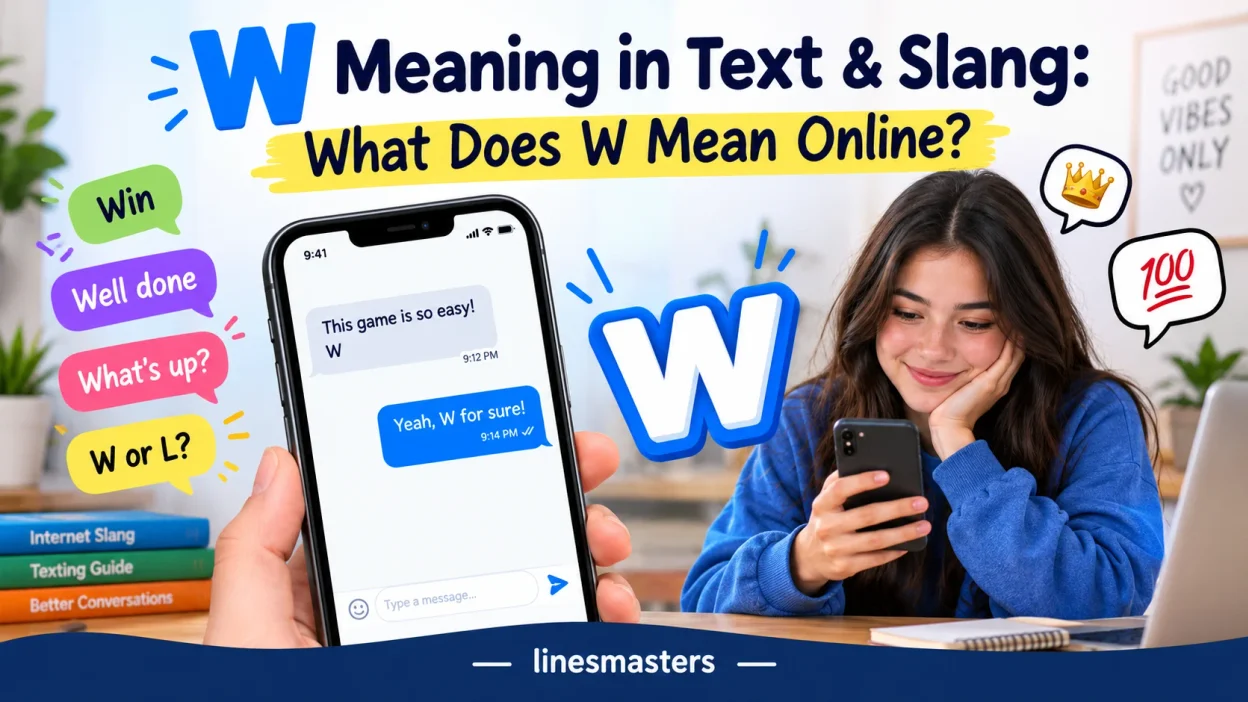
When scrolling through a text, message, comment, or group chat, W Meaning in Text & Slang: What Does W Mean Online? is often easy to understand.
A person may have replied with W instead of a full sentence or explanation. This little letter, or one letter, can carry real weight in digital communication. In casual digital conversations, W usually means win, showing success, praise, or approval of a decision or situation. When someone shares good news, makes a smart choice, or does something worth celebrating, W can be a simple way to celebrate it. The exact meaning, shade, and context can depend on the internet slang being used.
The W meaning is common on social media, in a post, gaming, and a gaming conversation. In a comment section, chat rooms, or TikTok, this shorthand expression can show something good or positive. It does not always involve a competition; helping someone, handling an awkward situation, or reaching an achievement can also be called a win. The origin of W connects to sports scorekeeping, where W means win, L means loss, and D means draw. The expression later evolved into popular internet slang, became widely used across different platforms such as Twitter, X, and Instagram, and remains a widely recognized part of digital and internet slang today. People use it because it is short, clear, and easy to understand, while the winner idea behind it continues through online communication and everyday messages.
Quick Answer:
W usually means “win” in texting and internet slang. It expresses approval, success, praise, or a positive outcome.
For example:
- You got the job? W! = That’s a win!
- That was a W. = That was successful or impressive.
- Big W! = That’s a major win!
- Common W. = That’s another success from someone who regularly does well.
- Take the W. = Accept or enjoy the victory.
The common opposite is L, which means loss or a losing outcome. Together, W and L provide a quick way to describe whether something went well or badly.
| Term | Meaning | Tone |
| W | Win | Positive |
| Big W | Major success | Celebratory |
| Huge W | Very impressive success | Highly enthusiastic |
| Common W | Expected or repeated success | Approving |
| W move | Smart or positive action | Complimentary |
| Take the W | Accept the win | Confident |
| L | Loss or failure | Negative |
What Does W Mean in Slang?
At its core, W is shorthand for “win.” It works as a compact reaction when someone wants to recognize a positive result without typing an entire sentence.
That simplicity explains much of its appeal. Instead of writing That was a really good decision, someone can type W and communicate the same basic idea in a fraction of the space.
The slang can refer to several kinds of positive moments:
- A victory in a game or competition
- An achievement such as passing an exam
- A smart decision
- A helpful action
- Good news
- An impressive performance
- A favorable outcome
- Something worth celebrating
For instance, imagine a friend says they finally finished a difficult project. A reply of W doesn’t necessarily mean they defeated another person. It means the result counts as a win.
That broader meaning is important. Internet slang often takes a word associated with one specific situation and stretches it into everyday conversation.
Why Does One Letter Mean So Much?
Digital communication rewards speed. A single W can act like a tiny verbal thumbs-up.
It also carries emotion. W feels more energetic than simply saying okay. Depending on the context, it can communicate congratulations, excitement, agreement, or admiration.
That’s why you’ll often see variations such as Big W, Massive W, or Huge W. Adding an adjective increases the intensity without changing the basic meaning.
How Is W Used in Text Messages?
Texting is one of the easiest places to understand W meaning in text because the surrounding conversation usually provides the clue.
Suppose someone writes:
I finally passed my driving test!
A friend might reply:
W!
The response means Congratulations — that’s a win.
Now consider a different situation:
I decided not to buy the expensive one. I found the same thing for half the price.
A reply such as That’s a W praises the decision. Nobody won a contest. The person simply made a choice that produced a good result.
W as a Standalone Reply
A single W can work as a complete reaction.
It usually means:
That’s good.
Nice.
You won.
Good decision.
That’s impressive.
The exact interpretation depends on what happened immediately before it.
“That’s a W”
This version sounds slightly more conversational.
For example:
- You helped your friend solve a difficult problem. → That’s a W.
- You found a great deal. → That’s a W.
- Your team won. → That’s a W.
Here, the phrase directly labels the situation as successful.
“W” as a Noun
People can also use W as a noun.
For example:
- We got a W tonight.
- That was an easy W.
- She earned the W.
In these examples, W functions much like the word win itself.
What Does W Mean on Social Media?
On social media, W often works as a public sign of approval. Someone can leave a single W in a comment to show that they support what happened in a video, post, debate, announcement, or story.
The meaning isn’t restricted to sports or gaming. Modern internet slang commonly uses W for anything users consider successful or positive.
W in Comments
Imagine a creator posts about reaching an important milestone.
Comments might include:
- W
- Big W
- Huge W
- Common W
- W creator
Each version communicates approval, although the intensity and wording differ.
W in Debates and Opinions
You may also see W take.
Here, take means an opinion or viewpoint. Calling someone’s opinion a W take means the commenter believes that person made a good point.
The phrase doesn’t necessarily mean everyone agrees. It simply signals that the commenter strongly approves of the argument or perspective.
W in Memes
Memes often exaggerate ordinary events. That’s where W can become humorous.
Someone might describe finding an extra snack in their backpack as a massive W. The situation isn’t actually a major achievement. The exaggerated language creates the joke.
So, when you see W in a meme, don’t always interpret it literally. Sometimes the humor comes from treating a tiny success like a championship victory.
Common W Slang Phrases and What They Mean
Several expressions have grown naturally around the basic W slang meaning.
Big W
Big W means a significant or impressive win.
If someone achieves an important goal, gets excellent news, or makes an especially smart decision, Big W fits naturally.
Example:
You got the scholarship? Big W.
Huge W or Massive W
These phrases turn up the enthusiasm.
Huge W and Massive W mean essentially the same thing: the situation represents a particularly impressive success.
The exaggerated wording often adds excitement or humor.
Common W
Common W usually suggests that success isn’t surprising because the person has a history of doing well.
For example:
Friend helps everyone with their homework.
Common W from you.
The speaker is basically saying, You did something great again. That’s very on-brand for you.
Take the W
Take the W means to accept or enjoy a victory.
It can apply to a literal competition or an ordinary situation.
If someone wins an argument, solves a difficult problem, or gets a favorable result, another person might say:
Just take the W.
In other words, enjoy the success and move on.
W Move
A W move is a smart, positive, or successful action.
For example:
You remembered to bring an umbrella.
Someone might jokingly respond:
W move.
The phrase praises the decision rather than the person as a whole.
W in the Chat
W in the chat is an online-style celebration. It asks or encourages other people in a digital audience to recognize a win.
The phrase fits especially well when several people are watching the same event or reacting together.
W vs. L: What’s the Difference?
If W means win, its common slang counterpart is L, meaning loss or a losing outcome.
The contrast is straightforward:
- W = positive outcome
- L = negative outcome
- Take the W = accept the victory
- Take the L = accept the loss
This W/L framework comes from the language of keeping score. Sports standings have long used W and L to distinguish wins from losses.
Online communities expanded that idea beyond literal scoreboards.
W and L in Everyday Situations
Consider these examples:
| Situation | W or L? | Why? |
| You finish a difficult assignment early | W | Positive result |
| You forget an important deadline | L | Negative outcome |
| You find a better price after shopping around | W | Smart result |
| You miss the bus by 30 seconds | L | Unfortunate outcome |
| Your team wins the match | W | Literal victory |
This makes W and L useful as quick internet scorekeeping language.
A person’s entire day can even be described as a mixture of Ws and Ls.
Where Did W Slang Come From?
The slang meaning of W has a straightforward connection to win-loss terminology in sports.
Sports records commonly use W to represent wins. For example, MLB’s official glossary uses W for a pitcher’s win and identifies it with victory.
That sports shorthand existed before today’s social media slang. Online communities then made the expression more flexible.
Gaming culture was especially well suited to the abbreviation because games constantly produce winners and losers. A quick W in chat can celebrate a successful match without interrupting the conversation.
Over time, social media broadened the meaning. Users began applying W to decisions, jokes, opinions, achievements, creators, and everyday moments.
That development explains why someone can call a kind gesture a W even though nobody technically “won.”
The Evolution in Simple Terms
Sports records → competitive communities → gaming conversations → social media → everyday internet slang
The exact history isn’t best described as one person inventing the slang on a specific date. The expression grew from an existing abbreviation and became increasingly common through online culture.
Read More : 301+ Future Pickup Lines in 2026
What Does W Mean in Different Contexts?
Context can change the flavor of W without changing its basic meaning.
| Context | Typical W Meaning | Example |
| Texting | Good news or success | “You passed? W!” |
| Gaming | Victory or successful play | “W!” after a match |
| Sports | Win or victory | “Another W tonight” |
| Social media | Approval or praise | “W creator” |
| Memes | Humorous success | “Found money in an old jacket. Huge W.” |
| Group chats | Celebration | “W for remembering that” |
| Online debates | Agreement with an argument | “W take” |
The important rule is simple: look at what happened immediately before the W.
If someone discusses a sports match, W probably means an actual win. If someone posts about making a smart purchase, W likely means a good decision.
Is W Always Slang?
No. The letter W has plenty of ordinary meanings outside internet slang.
It can simply refer to the letter itself. It can also appear as an abbreviation or symbol in specialized contexts.
That’s why context matters so much.
Compare these:
I got a W on the scoreboard.
Here, W relates to a win.
The word begins with W.
Here, W is simply a letter.
W! That’s amazing.
Here, the standalone letter clearly functions as internet slang because the surrounding sentence gives it a conversational role.
You shouldn’t automatically interpret every W as slang.
How to Use W Naturally in a Conversation
Using W isn’t complicated, but audience matters.
The slang works best in casual settings where the people involved already understand internet language.
Good Situations for W
Use it when:
- A friend shares good news.
- Someone achieves a goal.
- A person makes a smart decision.
- A team wins.
- Someone handles a situation particularly well.
- You’re reacting to an impressive online post.
- You’re joking about a small everyday success.
Situations Where W Doesn’t Fit
Avoid relying on it in:
- Formal academic writing
- Professional reports
- Official applications
- Formal business correspondence
- Serious situations where slang could sound dismissive
If you’re writing to a teacher, employer, institution, or official organization, success, congratulations, or excellent work will usually communicate your meaning more clearly.
A Simple Rule
Use W with people who already speak the language of the internet.
If there’s a chance the reader won’t understand it, spell out what you mean.
What Does We Mean From a Girl or Boy in Text?
The W meaning in text doesn’t change based on gender.
If a girl sends W, it generally means the same thing as when a boy sends W: win, approval, praise, or a positive reaction.
For example:
You finally finished the project!
W
That response signals approval regardless of who sent it.
It’s also important not to assign a romantic meaning automatically. A W isn’t inherently a flirtatious message. The surrounding conversation has to provide that meaning.
Examples
You: I got an A on my test.
Friend: W!
Meaning: Nice job!
You: I found the cheaper option.
Friend: That’s a W.
Meaning: Good choice.
You: Our team won.
Friend: Huge W.
Meaning: Great victory!
The sender’s gender doesn’t change the basic slang definition.
Is W Positive, Rude, or Sarcastic?
Most of the time, W is positive.
It usually communicates encouragement, approval, celebration, or admiration. However, internet language often depends heavily on tone, and W can sometimes be used sarcastically.
Genuine W
Someone gets good news.
W!
That’s straightforward praise.
Playful W
Someone finds an extra slice of pizza in the refrigerator.
Massive W.
The speaker probably isn’t claiming this is a historic achievement. The exaggerated praise makes the response funny.
Sarcastic W
Someone makes an obviously questionable decision and another person responds:
W move.
The words sound positive, but the surrounding context may reveal that the speaker actually means the opposite.
This is why W cannot be interpreted in isolation every time. Look at the message, the relationship between the speakers, and the tone of the conversation.
Real Conversation Examples of W Meaning in Text
Seeing examples makes the slang much easier to recognize.
Good News
Friend: I finally got accepted!
Reply: Big W!
Meaning: Congratulations on the success.
Smart Decision
Friend: I waited for the sale instead of buying it full price.
Reply: That’s a W.
Meaning: That was a smart choice.
Gaming
Player: We won that match by one point.
Reply: W!
Meaning: Congratulations on the victory.
Helping Someone
Friend: She stayed late to help everyone finish.
Reply: W from her.
Meaning: Her action deserves praise.
Social Media
Post: Someone shares a thoughtful community project.
Comment: Huge W.
Meaning: Strong approval of the project.
Small Everyday Win
Friend: I left five minutes early and avoided traffic.
Reply: Common W.
Meaning: Nice move, especially if that person regularly makes good decisions.
A Practical Way to Decode W Instantly
When you encounter W in a message, ask three quick questions.
What Happened?
Look at the event immediately before the response.
Was there a victory, achievement, decision, joke, or piece of good news?
Is the Tone Positive?
Words such as big, huge, massive, or common usually reinforce the positive meaning.
Is It Being Used Literally or Playfully?
A sports result may involve a literal win. A meme about finding a dollar might use W for humorous exaggeration.
This three-step approach usually gives you enough information to understand the intended meaning without overthinking a single letter.
Why W Works So Well as Internet Slang
There is something almost mathematical about the efficiency of W.
One character replaces an entire phrase:
W = That’s a win.
Big W = That’s a major success.
Huge W = That’s an especially impressive result.
The expression is short, recognizable, and adaptable. It also fits the fast rhythm of comment sections and group chats.
More importantly, we can move easily between serious and playful situations. A person can use it to celebrate a genuine achievement or jokingly praise something completely trivial.
That flexibility helps explain why the term has remained recognizable across different corners of internet culture.
W Meaning in Simple English
If the entire article had to be reduced to one sentence, it would be this:
W means “win” and usually tells someone that something was successful, impressive, smart, or worth celebrating.
Remember these essentials:
- W = Win
- W meaning in text = success or approval
- Big W = major success
- Huge W = very impressive success
- Common W = another expected success
- W move = smart or positive action
- Take the W = accept the victory
- L = the common opposite, meaning loss
- W is informal internet slang
FAQs:
What does W mean in text?
W usually means win or winner in online conversations. It is used to show success, approval, praise, or something positive.
What does W mean in slang?
In slang, W is a short way to celebrate a good result, smart choice, achievement, or successful situation.
Where did W slang come from?
The origin of W comes from sports scorekeeping, where W traditionally represents a win, while L means loss and D means draw.
How is W used on social media?
People use W in comments, posts, gaming conversations, and chat rooms to show support, celebrate success, or praise something they liked.
Does W always mean winning a competition?
No. W can describe many positive situations, such as helping someone, making a smart choice, handling an awkward situation, or receiving good news.
Conclusion:
W has become a simple and widely recognized piece of internet slang. Whether it appears in a text, comment, group chat, gaming conversation, or social media post, it usually communicates win, success, praise, or something positive.
Its meaning may depend on the context, but its basic use is easy to understand.

[…] Read More : W Meaning in Text & Slang: What Does W Mean Online? […]